Keeping Track of Family Milestones Before the Details Fade
Everyone remembers roughly when their child started walking. Almost nobody remembers the first genuinely funny sentence they said, even though it happened around the same time and felt unforgettable at the moment. That gap is worth paying attention to.
Family milestones have a strange property: the milestone itself is almost impossible to forget, but everything around it disappears fast. You will always know roughly when your child started school. You will not remember what they said on the walk home that first day, even though at the time you thought there was no way you would ever forget it.
Milestones survive, detail does not
This is not a memory failure — it is how memory is supposed to work. Big categorical events (first steps, first day of school, a grandparent's last visit) get filed as landmarks because they are structurally distinct: they only happen once, and they mark a before-and-after. Detail — the specific phrasing, the exact joke, the tone of voice — has no such structural anchor, so it is the first thing to erode.
- You will remember the year, sometimes the season, of a milestone. You will rarely remember the ordinary Tuesday around it.
- You will remember that your child "said something hilarious" at some age. You will not remember the sentence, unless you wrote it down within days.
- You will remember that a grandparent was sharp and funny "back then." You will not remember the specific story they told, unless someone recorded it.
Why detail fades faster than you expect
The reason is unglamorous: unrecorded detail depends entirely on retrieval, and retrieval decays every time it is not exercised. You do not lose a memory in one moment — you lose it gradually, across years of never revisiting it, until only the label survives ("funny thing," "good story," "sweet moment") and the content underneath is gone.
Parents in particular tend to overestimate how much they will remember, because in the moment a child's phrase feels burned in. It is not. The same brain that cannot recall a random Wednesday from six weeks ago is the brain that will be asked, five years from now, to reproduce the exact wording of a three-year-old's joke. It will not manage it, and that is normal, not a personal failing.
What a photo captures, and what it does not
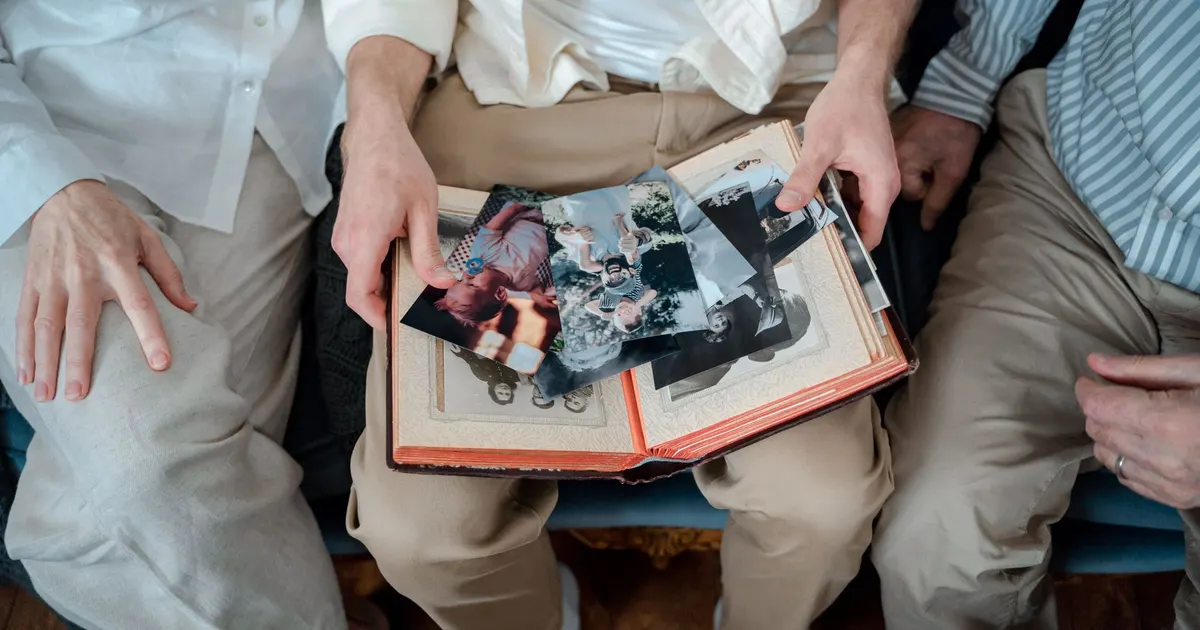
Photos are the default way families try to solve this, and they solve part of it well. A photo nails appearance: how someone looked, what a room looked like, a specific expression on a specific day. That is genuinely valuable and worth continuing to do.
What a photo does not capture is everything that made the moment matter. It does not record what was said, why everyone was laughing, what had just happened off-camera, or how anyone felt. A photo of your daughter's first day of school shows her backpack and her face. It does not show that she cried at the gate, that you almost turned back, or what she told you on the way home about being scared and then not scared.
- A photo preserves form: faces, places, objects, how something looked.
- A note preserves context: what was said, what it meant, how it felt, what led up to it.
- Neither replaces the other, and most family archives are almost entirely the first kind and almost none of the second.
The written line photos cannot replace
A single written sentence next to a photo, or even on its own, does something a photo structurally cannot: it carries the words, the reasoning, the joke, the specific detail that made the day what it was. "Asked why the moon follows the car" is eleven words and it will outlast almost every photo from that same week, because it is the one piece of that day nothing else recorded.
- Write down exact phrases, not summaries. "Said something about the moon" loses the thing that made it funny; the actual words do not.
- Note the context, not just the event. Who was there, what prompted it, what happened right before and after.
- Write it the same day. A child's phrasing, or an aging parent's specific story, is gone from your own memory within a week if unrecorded.
- Do not wait for a milestone to write something down. The ordinary Tuesday conversation is usually the one worth keeping.
Why this matters more for the people who are aging
The same erosion happens in the other direction, and it is easier to ignore because it feels less urgent in the moment. A grandparent's stories, the way they explain their own history, the specific phrases they use — these are not permanent. They are, in fact, on a clock that is easy to forget is running, because a person's presence makes it feel like there will always be another visit to ask again.
This does not require a formal interview or a big project, which is usually why it never happens — the imagined version is too large to start. A single sentence after a phone call or a visit is enough: what they talked about, a phrase they used, a story you had not heard before. Small and immediate beats thorough and postponed, here more than almost anywhere else.
Making the habit realistic
None of this works if it requires effort proportional to how much you love the person, because that guarantees you will do it rarely and inconsistently. The habit that survives is small: one sentence, attached to something you already do — right after a visit, right after tucking a child in, right after hanging up the phone. It does not need to be well written. It needs to exist at all, dated, so that five years from now there is something more specific to find than "I remember she said something funny once."
Common questions
- Isn't taking a lot of photos enough to remember this stuff?
- Photos preserve how things looked, not what was said or why a moment mattered. A photo of a birthday will not tell you what your child whispered to their grandmother that day. A short written note next to it carries the part a photo cannot.
- What if I've already lost years of these details?
- That is normal and not something to fix retroactively. The value is in starting now, not in reconstructing the past. A record that begins today and continues will hold far more than one that never started while you waited for a better starting point.
- How do I do this for an aging parent without it feeling morbid?
- Keep it ordinary. A line after a phone call — a story they told, a phrase they used, what they talked about — is not a project about their mortality, it is the same habit you would use for a child's phrase. Treating it as routine, rather than a special occasion, is what makes it sustainable.
RELATED APP
Keep the words, not just the photo
Memory Calendar gives each day a short note, so the exact phrase, the story, or the small detail behind a family milestone does not disappear the way unrecorded memory always does. Free, no forced login.